
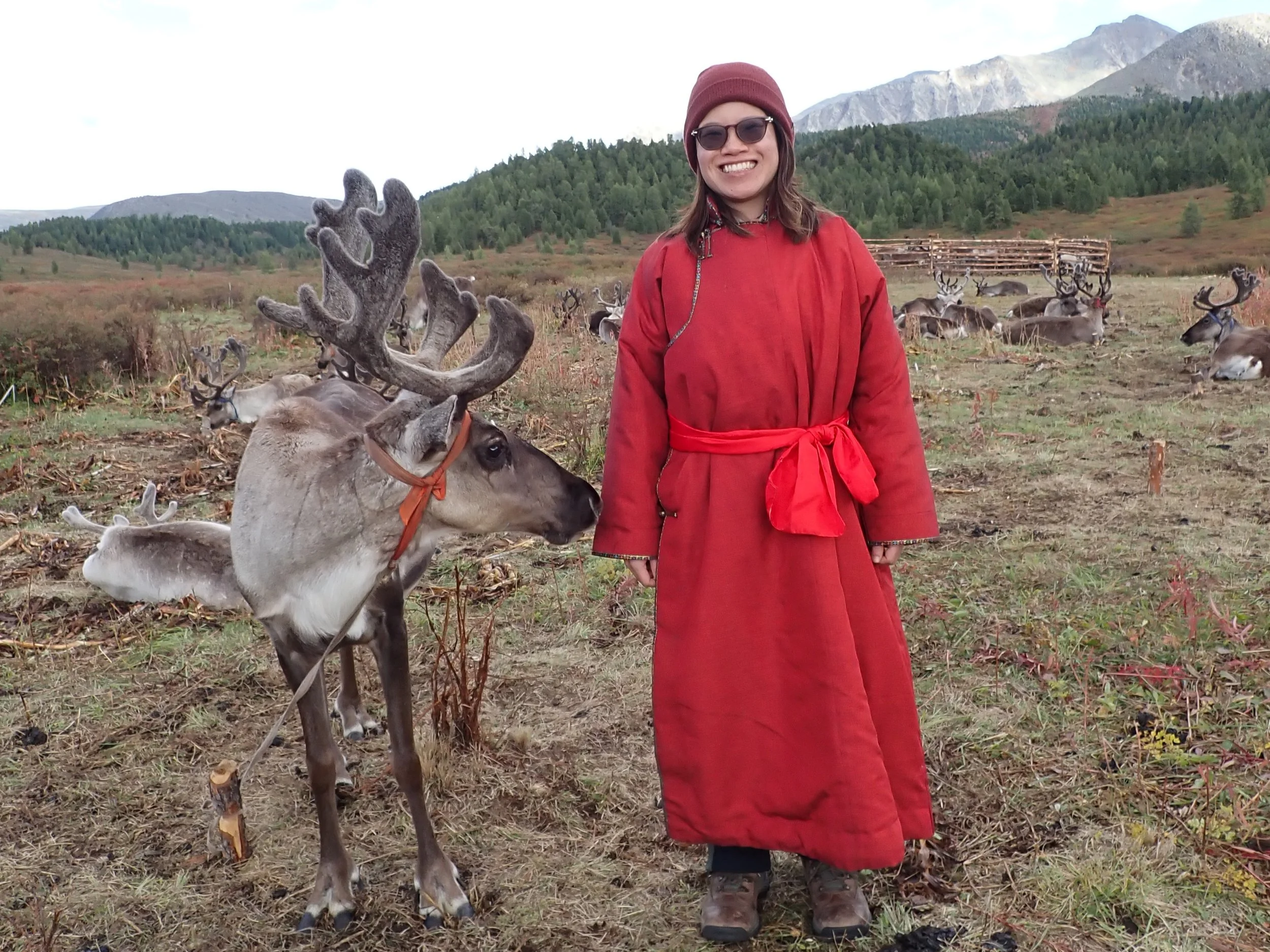
Yue Lin poses in her deel with Bayandalai's (a Tsaatan herder) reindeer Photo credit: Fiona McKeague.
Yue Lin Lee
September 9, 2026
This trip was a long time coming. I have been telling Julia for about four years now that I would come to one of her field schools. This year, I went on Session 4, to the Darkhad Depression and the Baruun Taiga to its west. and I was really looking forward to meeting the Tsaatan people and seeing the taiga.
I last traveled to the Darkhad in 2022, when I attended a Wilderness First Responder course that ran alongside one of Julia's field schools. We camped within sight of the gorgeous Khoridol Saridag mountain range. I remember being completely captivated by the tall peaks and thinking how lucky we were to be able to do our WFR in such a beautiful place.
Over the course of more than a decade, I have come to Mongolia numerous times and travelled all over the country for hiking trips and horse-trekking expeditions with my friends. That said, I was a little nervous going into the Darkhad taiga. Notwithstanding my years of riding the sturdy Mongolian horse through bog, marsh, and steppe, and over alpine passes and mountainous terrain, I had always felt that my ability to ride through the sometimes incredibly challenging Mongolian wilderness was due solely to the grace of my horse. And I had never ridden a Darkhad horse before.
I need not have worried. Our guides’ horses were all excellent—steady, sturdy and reliable. In fact, the first horse Mugii—one of our Tsaatan guides—gave me to ride reminded me so much of my horse in Sharkholoi (in central Mongolia) that I loved him immediately. Mugii subsequently switched him out for another horse because he felt the horse was misbehaving. I was pretty used to such antics, having been well-trained by my horse who had behaved in much the same way during our first year together. But I also appreciated the safety-first mindset of our group, especially since we had some first-time riders in the team.
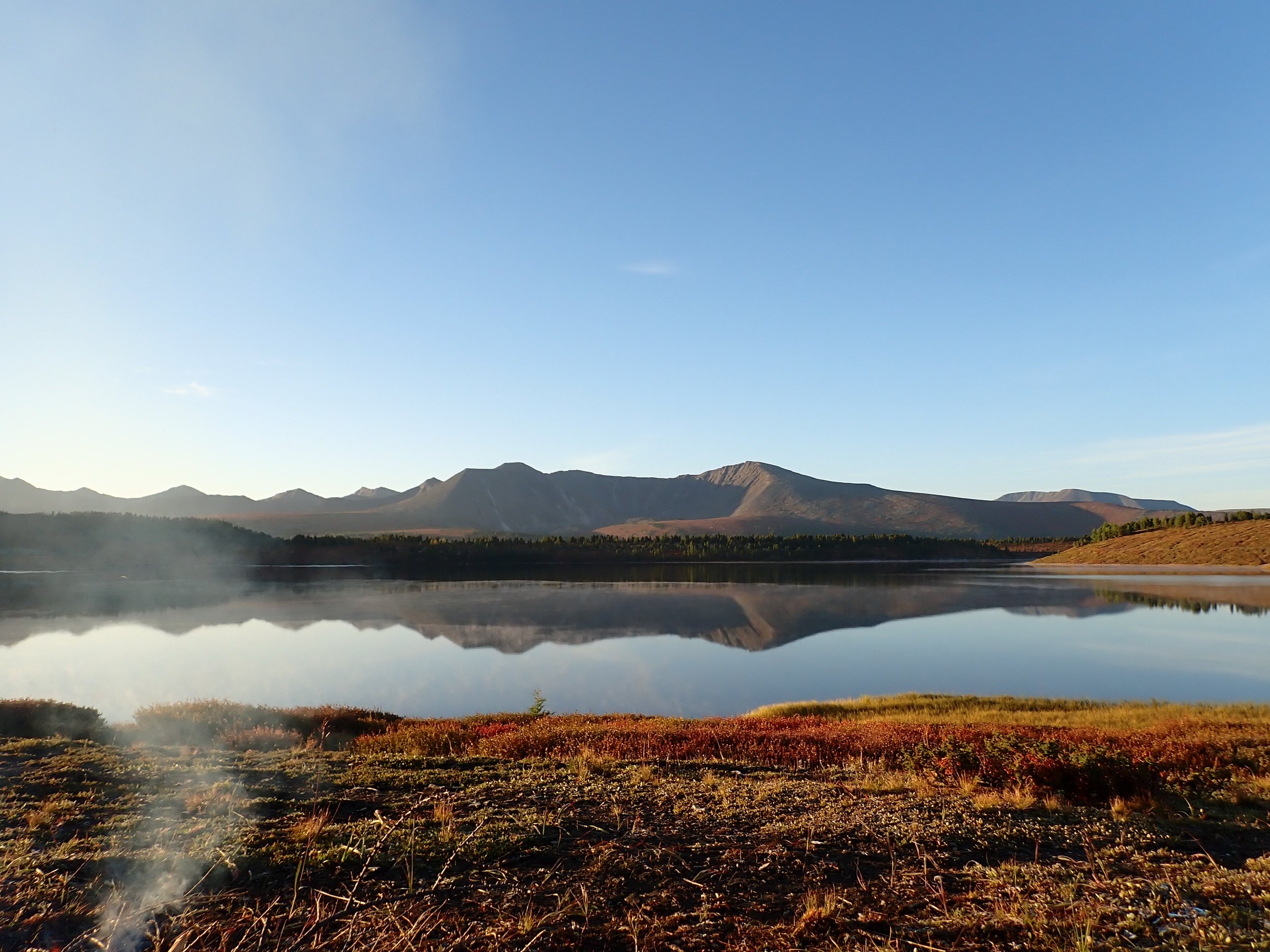
Khar Nuur (Black Lake), a stunning lake in the Darkhad Baruun Taiga (West taiga). Late morning. Photo Credit: Yue Lin Lee.
Session 4 is more of an exploratory field school, so the plan was to ride into new areas where NOMAD Science has not been before, looking for new sites. Our plans were based on information from our wonderful Tsaatan guides and friends, Ochiroo, Mugii, Uwe, Davaanuu, and Dalai, along with their friends and contacts.
As a non-archaeologist, to be able to come on this trip and see a part of Mongolia that I had wanted to visit for a long time was already a joy in and of itself. The fact that we actually did find some really cool archaeology sites—guided by our Tsaatan friends—was the cherry on top. It was a real privilege to see the taiga through their eyes, beginning to see that a close copse of trees with branches at just the right height would have served as a sur (pantry) in a winter camp, or to walk through dwarf birch to come upon neatly piled poles for an ortz (the Tsaatan’s traditional wood and animal hide tents) from decades prior.
Baruun Taiga is an extremely remote area of the taiga—a point that Julia would emphasise constantly in pre-trip briefings and Zoom meetings. She reinforced the point again when we arrived in the Darkhad, pointing out the region at the museum in Ulaan Uul where there was a useful diorama of the area’s mountains. Julia used the diorama to show us just how far from the nearest medical clinic we would be if anything should happen to us in the taiga.
The weather in the taiga is also changeable, ranging from hot and sunny days, to rain so cold it froze as it came down, to cold and frosty nights. One morning, I memorably woke to frost on the inside of my tent. Another night, we came home from the shaman's place and some team members could open their tent doors only with great difficulty - the tent seams had frozen shut.
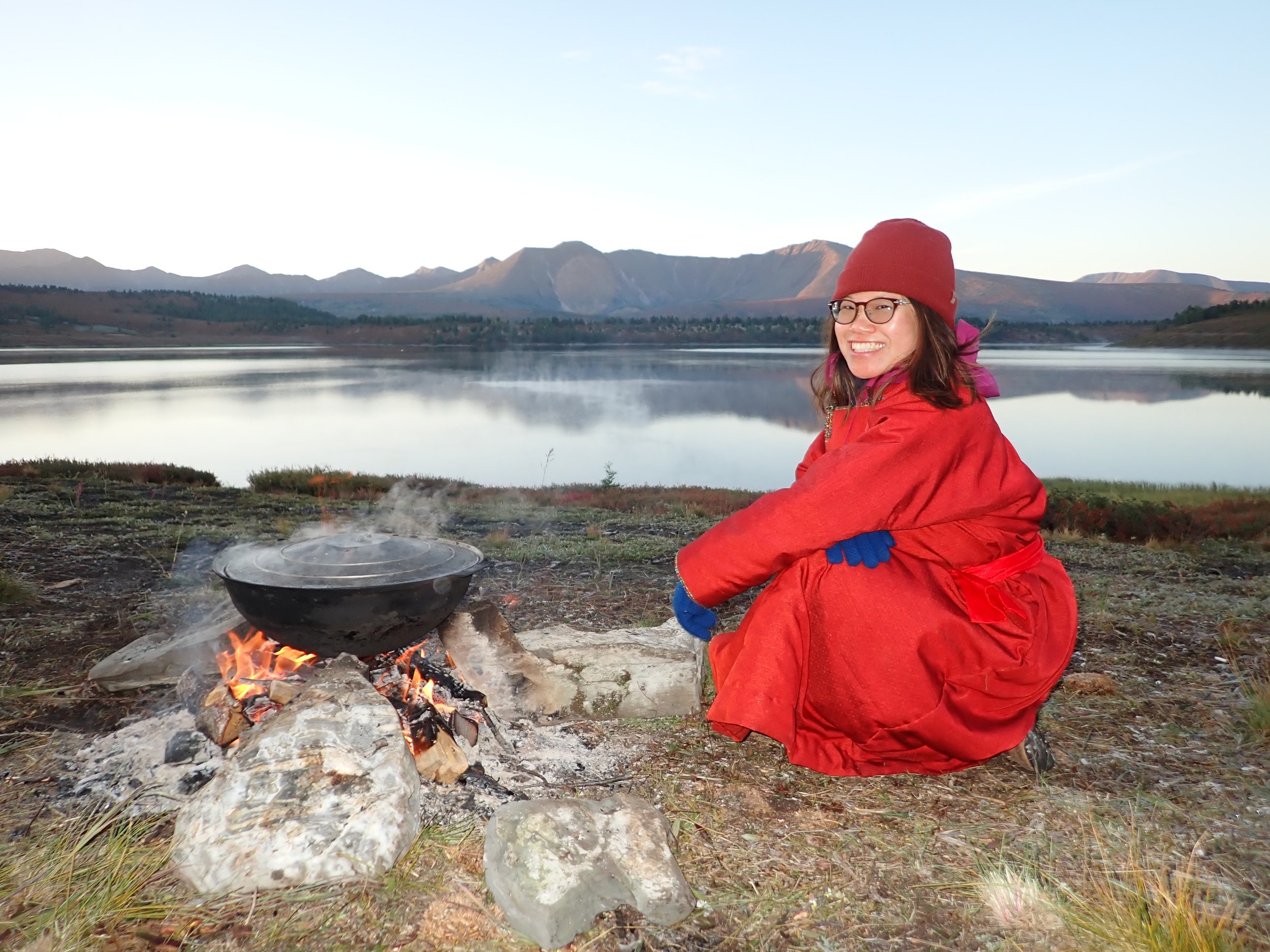
Early in the AM at Khar Nuur (Black Lake). Nothing like a hot cup of suutei tsai (Mongolian milk tea) on a frosty morning. Photo Credit: Munkh Ochir Ydam (aka Mugii).
To that end, I have set out below a non-exhaustive list of the gear and other items which I brought to the taiga and which have worked for me both in the taiga and on my other trips into remote parts of Mongolia.
To make the list more useful, I have also put down the specific brands and products that I know and love (though none of this list is sponsored!). And a final word of caution—I tend to run warm and do very well in cold temps, so if you tend to feel the cold more, I would recommend erring on the side of caution and packing efficient warm layers.
GEAR I BROUGHT TO THE TAIGA (A NON-EXHAUSTIVE LIST)
1) 35L Sea to summit dry bags (Big River model) x2. One for my tent, sleeping bags, sleeping pad; one for everything else.
2) Wechsel Bella 1.5-person tent. This tent is a 2-in-1, so the fly comes attached to the inner tent. It has only one pole and is very easy to set up in all weather. It is also super light and very cosy at night, with a relatively small footprint but with a roomy enough vestibule and inner tent that I could comfortably fit all my gear and my sleeping bag set-up in the tent.
3) Big Agnes Lost Ranger sleeping bag, Carinthia G40 sleeping bag liner, and a Sea to Summit compression sack. To save space, I only brought the inner bag of the Lost Ranger set-up, which I augmented with my sleeping bag liner. I was warm and toasty all through the trip—though as a general rule, I do also stay pretty warm even in cold temperatures.
4) A good sleeping pad.
5) Good rain jacket and pants. This is not the same as Goretex. Preferably, your rain jacket and pants should be totally impermeable to water. I really love my Columbia Titanium OutDry jacket that I bought years ago in UB.
6) Regular Goretex jacket and a good mid layer/fleece.
7) My winter deel (traditional Mongolian garb). I love my deel to pieces. It was the best thing to have in the taiga—my deel was a blanket, a coat, something to lay on when napping, a backrest or pillow when it was rolled up, a fire-starter, a basket for firewood, it kept my legs warm when riding on cold mornings and drastically reduced my need for any other warm layers.
8) Work gloves. I brought cheap cotton gardening gloves for protecting my hands when riding/carrying heavy things/collecting and breaking down firewood—let’s try not to get splinters in our hands.
9) Olympus TG7 camera. Shockproof, dustproof, waterproof, weatherproof and able to withstand very cold temps. The battery lasts three weeks out in the woods without problems.
10) Headlamp.
11) Cashmere buff; cashmere gloves; separate sleep socks that are only for sleeping in, also cashmere.
12) Montbell sandals. I have used and loved the Sock-on sandals from Montbell for many years. I really like ‘em because they don’t have velcro straps, and they are very thin and light. Sandals of any kind are great for when we camped near lakes and had time to go wading/swimming before dinner, or for airing your feet out and giving them a break from hiking boots.
13) Sturdy rain boots. These I purchased at Narantuul, the large market in Ulaanbaatar.
AOB
1) First aid kit and personal medicines. My personal medicine bag always has medicine for nausea, diarrhoea, constipation, gastric, cough, cold, sore throat, fever, pain, UTI, headache etc. I also like to bring muscle soreness cream/balm. Please go through your kit before departure and know how to use the items in your first aid kit.
2) Good moisturiser. I really like the Creme 21 moisturiser that comes in a tub which I buy from Nomin, a supermarket at the State Department Store in Ulaanbaatar. Don’t underestimate how cold and dry it can get in Mongolia. Even if you typically do not moisturise, please moisturise from day one.
3) Good sunblock, lip balm, and Vaseline. I really like the Sunplay Super Block SPF 130. Do not underestimate how strong the UV rays are in Mongolia.
4) Eye drops. Don’t underestimate how dry the air gets in the taiga!
5) Electrolytes.
6) Wet wipes for “bathing.” I also really like bringing micellar wipes for cleaning my face.
7) Small and sturdy trowel for digging your personal toilet; hand-sanitiser.
8) Fun sweets/gummies. Great for sharing mid-trip as a post-dinner snack or group pick-me-up.
9) Small items from home to share with your new Tsaatan friends. I brought individual packets of tea/coffee mix; other friends brought bandanas feat. artwork from home and local teas.
10) Nail clipper / little pocketknife. Please know how to use any little knives you bring.
11) Dry shampoo. I really like the Spes dry shampoo lotion because it comes in a small tube and isn’t an aerosol like many of the dry shampoos on the market. I have also seen dry shampoo powder on the market.
12) Environmentally friendly liquid soap/soap leaves/soap bar.
13) Good insect repellant. I am usually a mecca for mosquitoes, so I always bring Lifesystems Expedition MAX DEET mosquito repellant with me. On this trip, the midges were actually worse, and I think Lifesystems sells midge repellant as well.