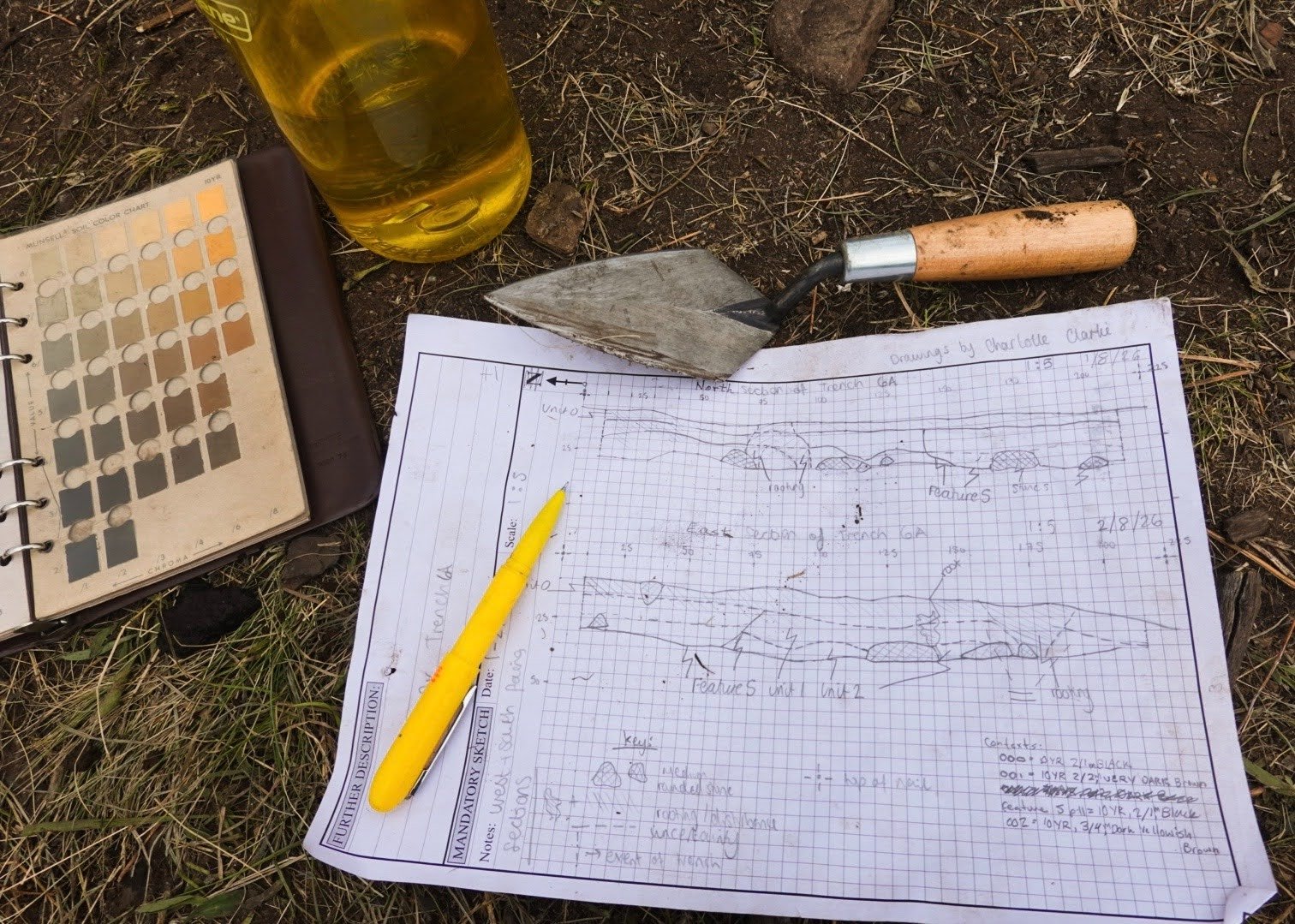
At work analyzing the soil and stratigraphy of our excavation site. Photo Credit: Phoebe Veitch.
Phoebe Veitch
July 25, 2026
Ever since I was a small child, I have loved field guides. As a 6-year-old, I toted around glossy books of birds in my tiny suitcase when travelling, the laminated pages showing the hundreds of different species I might encounter. Each book’s edges fuzzed over time, worn by my tiny hands, always searching out a new wonder wherever I ventured. As I’ve grown up, my interest in birds has faded. But my love of a good guide and categorizing system has remained.
My senior year of high school, I worked under an archaeologist in my home state of Maine, analyzing local artifacts. Nearing retirement, my boss was cleaning out his office, and gave me a kingly gift—the Munsell Soil Color Guide, the golden grail of archaeologists. The Munsell is the standard way to compare soil colors across sites and continents, helping archaeologists infer chronologies and series of events from layers of differently-colored soils. It is an essential tool for a field archaeologist—but new, a single booklet can cost upwards of $300.
My boss’s gift was a gesture of faith in my career as an archaeologist, and I have been longing for the chance to use it ever since. After a few days of digging in August at the site of Shar-Uul, that opportunity arrived. I overheard our leadership mention soil color and our need to evaluate it. I quickly hopped out of the trench and made my way over to where our geoarchaeologist, UT Austin’s Dr. Arlene Rosen, stood. I feigned nonchalance as I inquired on whether soil color was being taken—and how. Arlene pointed to her Munsell guide.
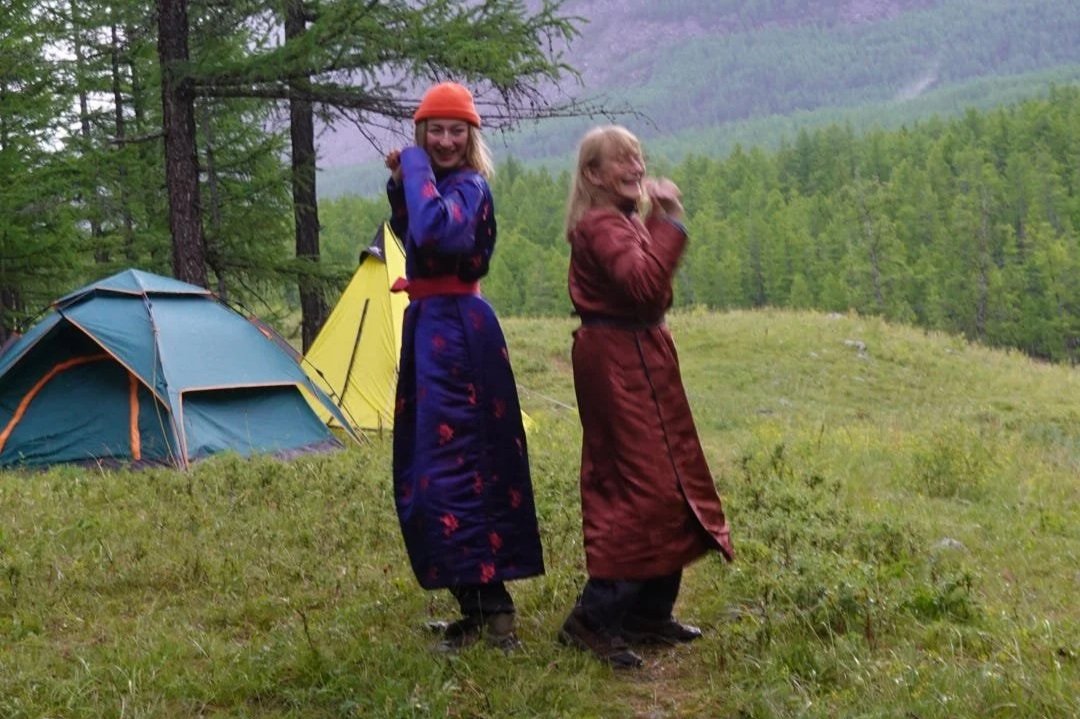
Phoebe and Arlene celebrate their work back at camp. Photo Credit: Phoebe Veitch.
Only an archaeologist, I thought, could be as excited as I was about dirt. I asked if Arlene would train me, and we sat down with the booklet. I was an eager student, and Arlene an eager teacher—she later confessed to me that she found Munsell colors quite tedious, so she welcomed my zeal. We compared the colors of the soil with the various colors in the booklet, noted the result, and moved on to the next layer.
The process was simple. But to use a Munsell in the field had been my dream for years, ever since that gift in my senior year of high school. Here I was, in Mongolia, living out that dream. I was overjoyed. I’ll remember that day every time I use the Munsell, in what I hope to be a long career in archaeology.