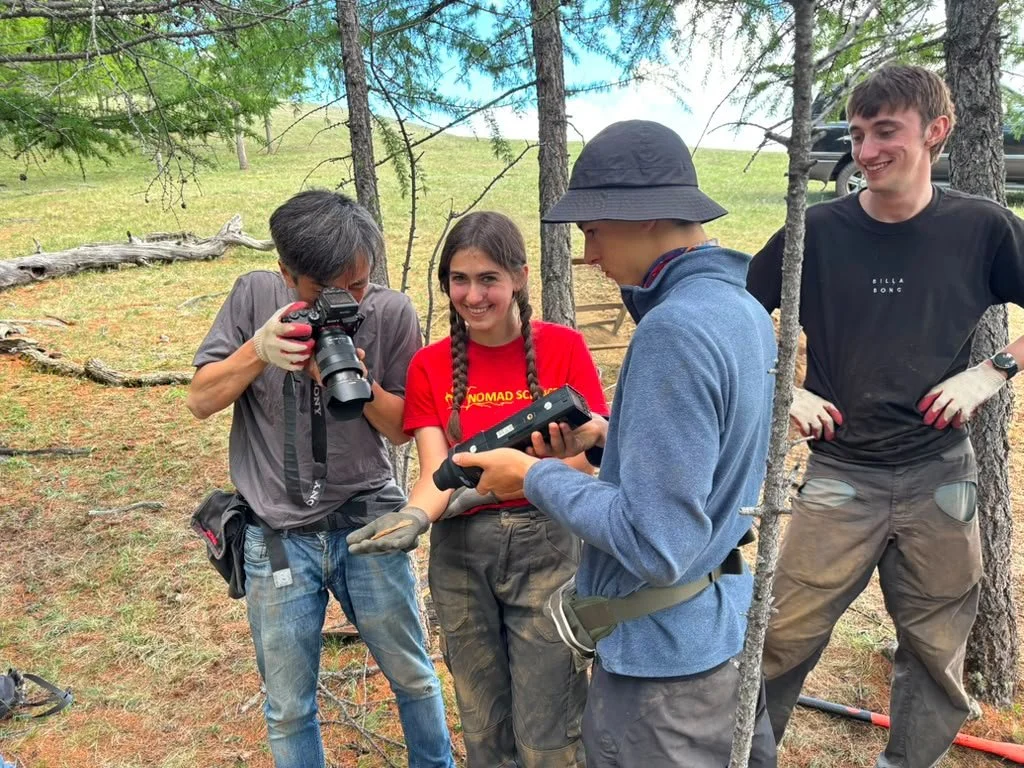
National Geographic photographer Justin Jin works his magic. Photo Credit: Molly Brooks-Jennings
Miranda Selin
July 8, 2026
Among the trees on the slope of Khankhmait, I am helping excavate a looted Mongol-period grave. My team is just off the ridge line, where the Mongols often buried their elite, so we have the most beautiful view out over the hills. I can see a ger in the valley down below. There are little yellow wildflowers around us. Best of all, the burial we are working on is yielding some very cool stuff.
Most burials that NOMAD Science excavates have been looted. Some were robbed in antiquity, but many were disturbed in just the last decade; a huge surge started in the 2010s. Modern looters work quickly to find items that they can sell on the black market. They usually don’t care about—and so leave behind—human and animal bones, which have some of the richest information for us via DNA, proteomic, and isotopic analysis. And in their rush, the looters often miss artifacts which can help us better understand Mongolia’s history.
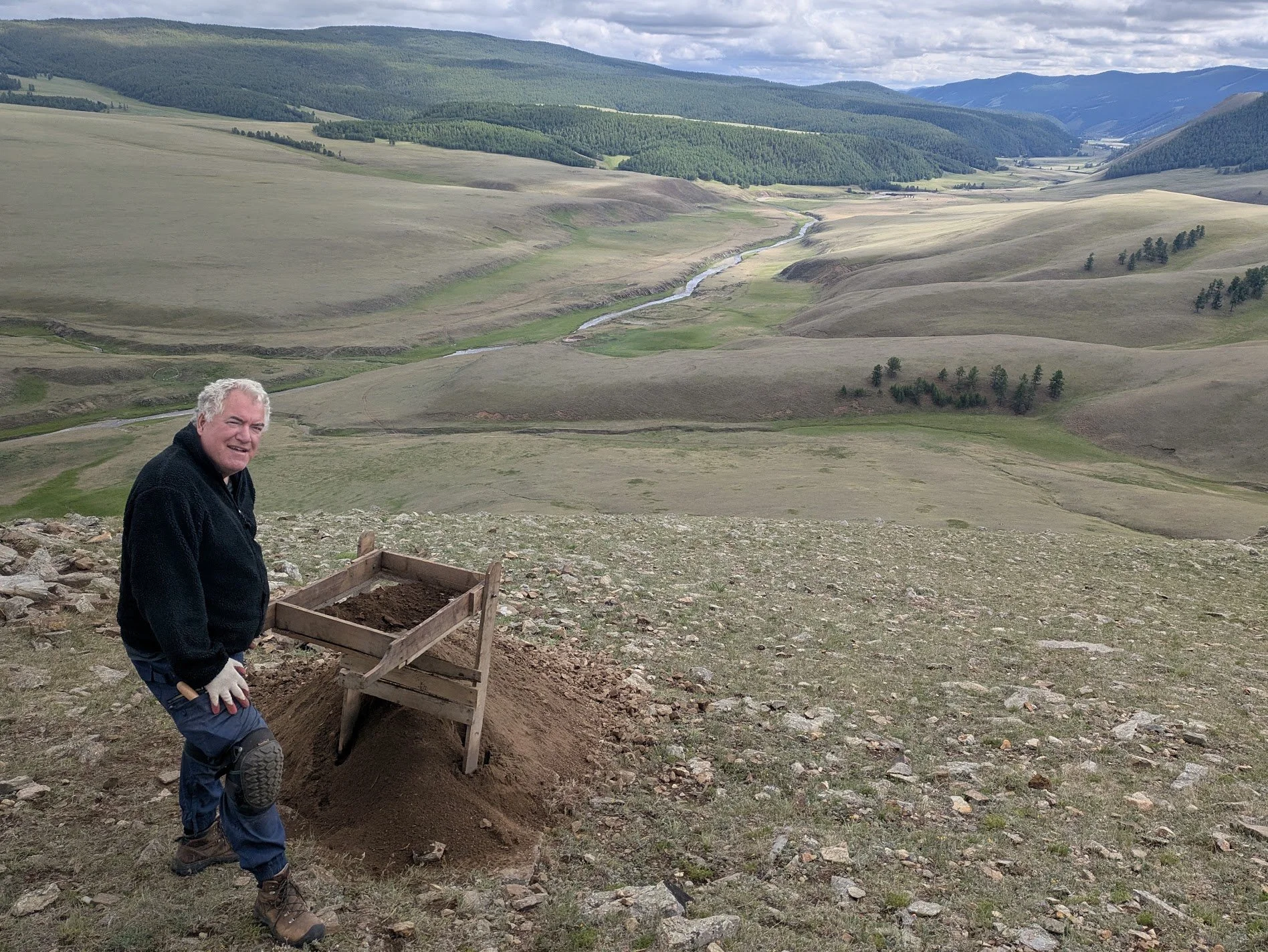
NOMAD student Peter Carty sieves with a view. Photo Credit: Peter Carty.
Today, I am searching for those left-behind treasures while on sifting duty. I shake the dirt from the pit over mesh sieves and look for artifacts and bits of bone. Mostly, I find rocks and roots. Ale—one of the other students, and a good friend of mine—is helping me look through the sieve. Just as I stop shaking, he plucks out an iron arrowhead. The whole crew cheers. And just a few minutes later, National Geographic photographer Justin Jin arrives at our site.
The photographer takes the arrowhead and arranges it this way and that in Ale’s hand, searching for the best angle. The arrowhead is put on his palm, along his finger, grasped between two fingers, showing first the corroded side, then the other. The photographer’s assistant plays with the lighting. We stop sifting for a few minutes so that we don’t coat the camera lens with dust. Eventually, the photographer stops, looks at Ale (who is six foot four) and decides his hands are too big for the shot. They make the arrowhead look tiny. And so, in pursuit of the perfect photo, the arrowhead ends up in my hands. Maybe—fingers crossed—I will soon be able to see my own gloved hand in the Nat Geo magazine.